

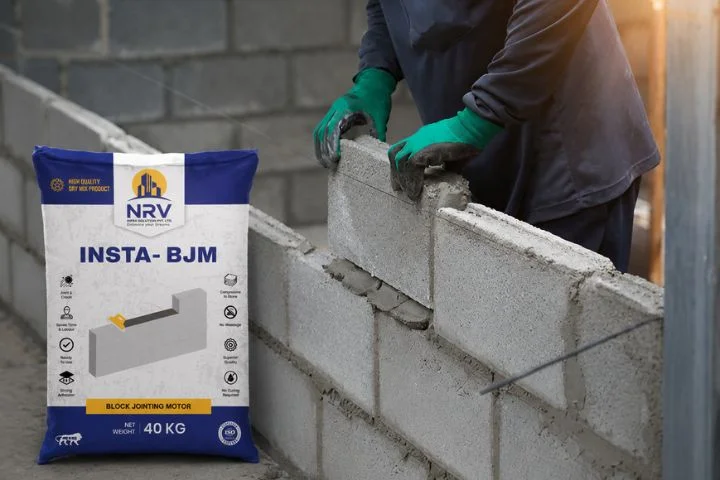
AAC Block Jointing Mortar is a factory-made, cement-based adhesive specially designed for joining AAC blocks using thin joints. It provides strong bond strength, faster installation, reduced material consumption, and better wall alignment compared to conventional cement-sand mortar, making it a preferred choice for modern masonry and wall construction projects.
What is AAC Block Jointing Mortar?
AAC block jointing mortar is a high-performance masonry material used for laying Autoclaved Aerated Concrete (AAC) blocks. It is commonly made from cement, graded sand, polymers, and performance-enhancing additives that improve adhesion and workability.
Unlike traditional masonry mortar, which requires thicker joints, AAC block jointing mortar is formulated for thin joint application, typically between 2–3 mm. This design helps create stronger and more uniform masonry structures.
The primary purpose of this AAC block adhesive is to ensure precise block laying, minimise gaps, and provide a durable bond between AAC blocks. Because AAC blocks are dimensionally accurate, they perform best when paired with a specially engineered block-jointing mortar rather than conventional mortar.
Key Benefits of AAC Block Jointing Mortar
AAC Block Jointing Mortar offers several advantages that improve both construction quality and site productivity:
- Strong bonding performance that enhances wall stability and durability
- Reduced material consumption due to thin joint application
- Faster installation compared to traditional mortar systems
- Improved workability for easier handling and application
- Uniform wall alignment and smoother surface finish
- Reduced wastage and cleaner construction sites
- Higher construction productivity and faster project completion
These benefits make it a preferred building material for efficient construction and high-performance masonry applications.
Applications of AAC Block Jointing Mortar
AAC block jointing mortar is suitable for a wide range of masonry and wall construction projects:
- Residential buildings, villas, and apartment complexes
- Commercial offices, retail spaces, and mixed-use developments
- Industrial facilities and manufacturing units
- Educational institutions, hospitals, and public infrastructure
- High-rise construction projects requiring precision masonry work
Its versatility and consistent performance make it suitable for both small-scale and large-scale modern construction projects.
AAC Block Jointing Mortar vs Traditional Cement-Sand Mortar
The primary difference lies in performance, efficiency, and application thickness.
| Parameter | AAC Block Jointing Mortar | Traditional Mortar |
| Joint Thickness | 2–3 mm | 10–12 mm |
| Material Consumption | Lower | Higher |
| Bond Strength | Strong and consistent | Moderate |
| Application Speed | Faster | Slower |
| Wastage | Minimal | Higher |
| Surface Finish | Smooth and uniform | Less uniform |
| Productivity | Higher | Lower |
AAC Block Jointing Mortar enables precision block laying with thinner joints, resulting in reduced material usage and improved wall quality. Traditional cement-sand mortar requires thicker joints, leading to greater consumption, longer application time, and higher wastage.
For projects focused on speed, consistency, and quality, Thin Bed Mortar solutions provide a clear advantage.
How AAC Block Jointing Mortar Improves Construction Efficiency
Construction efficiency depends on speed, consistency, and quality. AAC block jointing mortar supports all three.
Because it uses a thin application layer, masons can lay more blocks in less time. This accelerates project schedules and helps contractors meet construction deadlines more effectively.
The mortar’s engineered composition provides consistent performance throughout the project. Unlike site-mixed masonry mortar, factory-produced materials offer predictable results and improved quality control.
Builders also benefit from easier handling and reduced mixing requirements. The result is improved masonry quality, better wall alignment, and greater productivity on site.
In large residential and commercial projects, these advantages can contribute significantly to overall project efficiency and cost optimisation.
Best Practices for Application
Proper application ensures maximum performance and long-term durability:
- Clean AAC block surfaces before application and remove dust or loose particles.
- Mix the mortar according to the manufacturer’s recommendations until a smooth consistency is achieved.
- Apply using a notched trowel to maintain a uniform joint thickness of approximately 2–3 mm.
- Ensure blocks are aligned accurately during placement for consistent wall construction.
- Follow recommended curing practices and protect newly constructed walls from excessive moisture or direct exposure during initial setting.
Adhering to these practices helps achieve strong bonding performance and optimal masonry results.
Why Builders Choose AAC Block Jointing Mortar
Builders, contractors, and engineers increasingly prefer AAC Block Jointing Mortar because it aligns with the demands of modern construction.
It delivers superior bond strength and better dimensional accuracy compared to traditional masonry mortar. This helps create walls with improved structural integrity and appearance.
The material also supports efficient construction by reducing labor effort, minimizing material wastage, and improving installation speed. These advantages are particularly valuable in large residential developments, commercial complexes, and high-rise projects.
Long-term wall performance is another important factor. Properly installed AAC Block Adhesive systems help reduce cracks associated with uneven joints and poor bonding, contributing to durable masonry structures.
Why Choose NRV Infra AAC Block Jointing Mortar
Quality and consistency are critical when selecting construction materials. NRV Infra focuses on providing AAC Block Jointing Mortar that supports reliable masonry performance and compatibility with modern AAC block construction systems.
Through controlled manufacturing processes and quality-focused production, Nrv Infra Solutions help contractors and developers achieve uniform wall construction and efficient project execution.
For projects that prioritize high-performance masonry, reduced material consumption, and dependable construction outcomes, a consistently manufactured jointing mortar can make a measurable difference in overall quality and productivity.
Building Better Walls with AAC Block Jointing Mortar
AAC Block Jointing Mortar has become an essential component of modern masonry construction due to its strong bond strength, faster application, reduced material consumption, and superior wall finish. Compared to traditional cement-sand mortar, it offers significant advantages in productivity, quality, and long-term performance.
From residential homes to large commercial and industrial projects, this specialised block jointing mortar supports efficient construction and reliable wall construction outcomes. When paired with quality AAC Blocks and proper installation practices, it helps deliver durable, high-performance masonry structures that meet the demands of today’s building industry.
For builders, contractors, architects, and developers seeking dependable masonry solutions, NRV Infra offers construction materials designed to support quality, consistency, and modern construction excellence.
Frequently Asked Questions
Q1. What is AAC block jointing mortar used for?
Answer: AAC Block Jointing Mortar is used for joining and laying AAC blocks in masonry construction. It creates a strong bond between blocks using thin joints, improving wall alignment, reducing material consumption, and enhancing construction efficiency compared to conventional cement-sand mortar.
Q2. How is AAC block jointing mortar different from traditional mortar?
Answer: AAC Block Jointing Mortar is specifically designed for AAC Blocks and is applied in thin layers of about 2–3 mm. Traditional mortar requires thicker joints, consumes more material, and generally provides lower productivity. Jointing mortar also offers better adhesion, cleaner application, and improved wall finish.
Q3. What is the ideal joint thickness for AAC Block Jointing Mortar?
Answer: The recommended joint thickness is typically between 2–3 mm. This thin bed application promotes stronger bonding, better dimensional accuracy, reduced wastage, and improved thermal performance compared to thicker conventional mortar joints.
Q4. Is AAC block jointing mortar suitable for residential and commercial projects?
Answer: Yes. AAC block jointing mortar is widely used in residential buildings, commercial complexes, industrial facilities, hospitals, schools, and high-rise developments. Its strong bonding capability and efficient application make it suitable for a broad range of masonry applications.